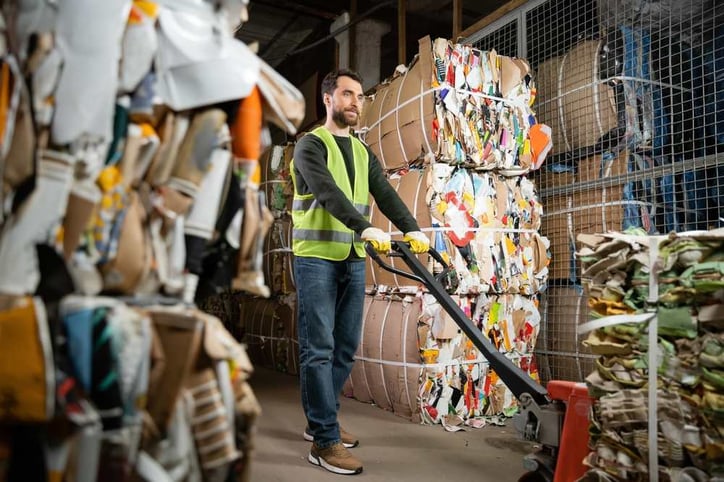
TL;DR: Logistics packaging and pallet waste can quickly become an operational burden when removal, reporting, and recovery practices are not aligned across sites. This blog explains that efficient logistics waste management depends on cleaner material separation, stronger service alignment, and more consistent packaging waste processes across the network. Note that the EU law functions more as a ticking clock for US operating companies, not as a force of compliance today.
- Packaging waste creates friction because it builds up around active work areas, takes up productive space, and can interfere with throughput when staging and removal fall behind.
- Corrugated cardboard is often the strongest recovery opportunity, while plastic film and damaged pallets require more deliberate handling to avoid contamination and space loss.
- Packaging and packaging waste regulation is becoming more demanding, which makes material tracking, cleaner downstream documentation, and multi-site consistency more valuable.
- Better logistics companies' packaging waste management starts with separation at the point of generation, then improves through service schedules that match actual waste volume.
- RoadRunner supports logistics waste disposal with a managed approach that improves reporting and helps reduce avoidable waste costs.
Logistics waste disposal is a growing operational issue for many supply chain facilities. Packaging waste builds up quickly as goods move through a site. As a result, pallet waste can take over valuable floor space when removal is inconsistent. That affects costs and service planning while making logistics waste management harder to standardize across a network.
In this blog, we’ll provide our top recommendations for how logistics organizations can more efficiently manage packaging and pallet waste to boost sustainability and day-to-day efficiency.
Why Logistics Waste Disposal Creates Ongoing Friction
While the most recent comprehensive EPA baseline cited 82.2 million tons of waste, current industry trends suggest these volumes have intensified with the e-commerce surge of the early 2020s. This makes sense when you consider that packaging enters most logistics operations from multiple directions.
Both inbound and outbound freight and shipments involve wrapping, pallets, boxes, and more, generating a near-constant stream of packaging waste. All of that waste has to be consolidated, staged, and ultimately removed. Ideally, facilities can accomplish this without disturbing throughput. If not, facilities end up with clutter near some of their most high-traffic areas, like docks and work zones.
Ultimately, when handled poorly, waste competes with productive space, which can create operational challenges even before you’ve filled a single container.
Packaging Waste in Logistics Operations
According to recent government data, corrugated boxes are one of the most frequently recycled packaging products in the United States. For logistics companies, cardboard is often the clearest recovery opportunity. Corrugated cardboard is typically generated in predictable volume and can produce rebate value when kept clean and dry.
Plastic film is also abundant, accumulating quickly around receiving and pallet breakdown areas, but compared to cardboard, it comes with more operational challenges. In many Materials Recovery Facilities (MRFs), plastic film is considered a system contaminant because it can wrap around sorting equipment and disrupt processing.
While lightweight, plastic film has little to no market value when mixed with general trash or other recyclables. To be recovered effectively, plastic film usually needs to be kept clean, separated at the source, and baled on its own. Otherwise, it creates a visible handling problem and increases the likelihood that material is discarded instead of diverted.
Pallet waste, likewise, demands its own process. Damaged pallets can stack up near active work zones, holding onto space that should support operations. They often end up piling up and lingering when there is no regular outlet or pickup rhythm.

Packaging and Packaging Waste Regulation: What Logistics Teams Should Know
Packaging and packaging waste regulation is becoming more concrete in 2026, especially for companies that move goods across multiple states or support brands with national programs. As a general trend, legislation is shifting more of the financial and reporting burden for packaging waste onto producers.
Even when a logistics company is not the legally obligated producer, these laws can still affect day-to-day operations. For example, customers may ask for cleaner material separation. There may also be a demand for better packaging data or more consistent downstream documentation.
For logistics teams, this means:
- Contamination can create bigger downstream problems because mixed loads weaken recovery performance and marketability
- Multi-state consistency is becoming more valuable, so a logistics company with scattered local practices will have a harder time answering customer questions or adapting to new requirements than one with a consistent internal reporting structure.
And global supply chains face even more pressure. In the EU, Regulation (EU) 2025/40 will replace the older packaging directive from August 12, 2026. The regulation sets sustainability and labeling requirements across the packaging life cycle and is intended to reduce unnecessary packaging while promoting reuse, refill, and recycling. Logistics teams serving international brands may feel that pressure even before the law goes into place.
Ultimately, better packaging data and cleaner material separation make it easier to respond when stakeholders begin to ask harder questions about your logistics operation’s waste performance.
Best Practices for Logistics Companies' Packaging Waste Management
Efficient logistics waste management always starts with separation at the point of generation. The goal is not neatness for its own sake. Clean material has a stronger recovery value, and clean streams are easier to measure.
The next step is aligning service with actual volume. Overflow often signals a mismatch between generation patterns and pickup schedules. Empty containers on frequent service can point to overspending. Waste handling works better when removal patterns reflect what the site is truly producing.
Finally, consider network consistency. For example, a logistics company may have one site that captures cardboard effectively, while another sends similar material to landfills because the local setup is weaker. Standard operating rules can solve those problems.
The same is true for pallet staging and rebate administration. When each location follows its own process, reporting becomes less useful. At the same time, waste costs become harder to compare.
How RoadRunner Supports Logistics Industry Waste Solutions
RoadRunner helps logistics companies bring more structure to packaging waste and pallet waste removal across their facilities. With a managed approach to service and reporting, logistics facilities can reduce avoidable waste costs and keep their material flows from disrupting their operations.
Learn more about our logistics waste disposal service today.
