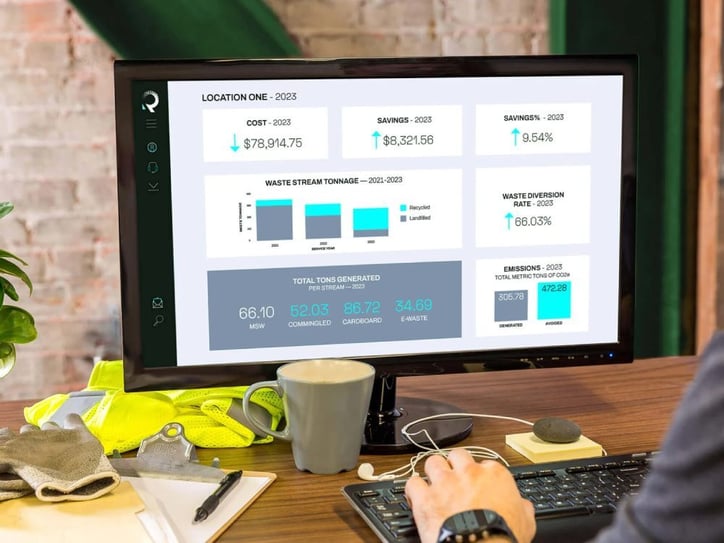
TL;DR: Real-time waste management data gives manufacturers the visibility they need to reduce costs, improve sustainability, and increase operational efficiency. This blog explains how data-driven waste management helps organizations make smarter decisions that strengthen ROI while supporting long-term environmental goals.
- Learn how real-time waste data uncovers hidden disposal costs and service inefficiencies.
- Discover how waste management data analysis improves recycling, vendor performance, and budgeting.
- See how waste data reporting supports sustainability initiatives and regulatory compliance.
- Understand how big data waste management helps manufacturers optimize waste streams and reduce landfill reliance.
- Explore how effective waste management and waste reduction contribute to stronger financial performance.
Manufacturers know the value of good operational data. Production output, inventory, labor, downtime, and equipment performance are measured because small inefficiencies multiplied across thousands of production hours can become major expenses.
Waste deserves the same scrutiny.
A monthly invoice can tell you what you paid for waste service. It cannot tell you how full a container was when it was collected, if recycling contamination is increasing, or if one plant is consistently receiving more service than it needs.
That is where waste management data becomes valuable. RoadRunner uses proprietary technology to collect and analyze information from waste operations, giving manufacturers timely visibility into what is happening across individual facilities and their entire portfolio.
More importantly, RoadRunner turns that information into action.
Why Waste Data Matters in Manufacturing
Manufacturing waste streams rarely remain constant. Production volume changes. Product lines come and go. Materials and packaging change. Seasonal demand can send output sharply upward or downward.
Waste service, however, may remain exactly the same.
That creates a disconnect between the service a facility receives and the service it actually needs. Containers may be collected before they are full. Another location may experience recurring overflows. Valuable recyclable materials may disappear into the general waste stream.
RoadRunner helps close that information gap.
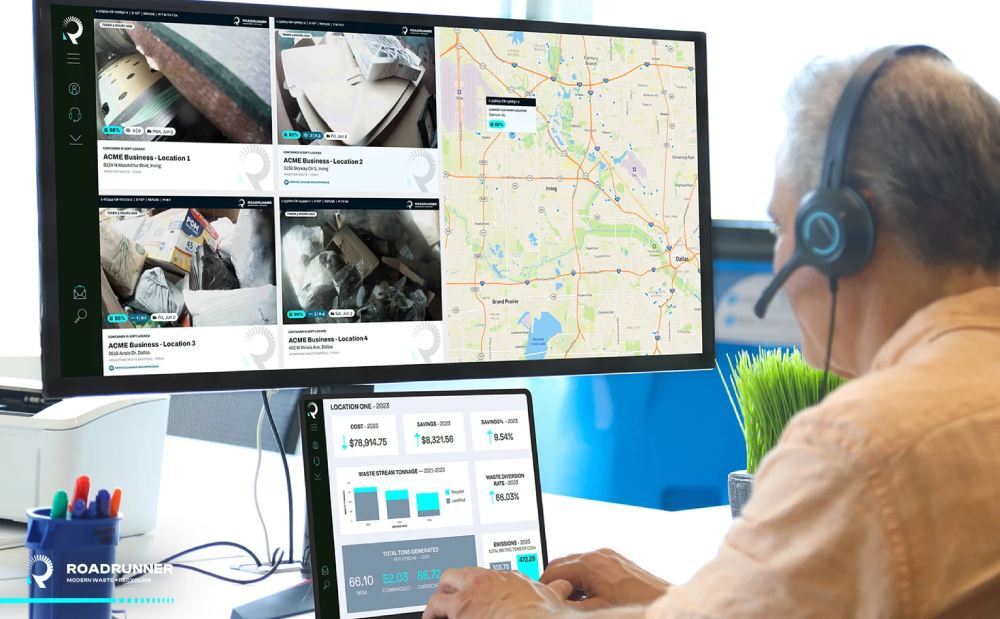
Its patented Waste Metering™ technology uses AI-powered cameras installed in containers to monitor fullness, contents, contamination, and service activity. The technology collects daily operational information, giving RoadRunner’s waste experts a much clearer understanding of how a facility actually generates waste.
That waste data can reveal opportunities that invoices and fixed service schedules simply cannot.
Waste Metering™ Turns Containers Into Data Sources
Think of a dumpster as another piece of manufacturing infrastructure. If you had a production machine operating at half capacity but being serviced as though it were running at 100%, you would want to know.
Waste Metering™ brings that type of visibility to waste operations.
RoadRunner uses its technology to track container fullness, fullness at pickup, contents, contaminants, and service events. AI then analyzes those data points to identify potential adjustments to container size, type, and service schedules.
This makes waste management data analysis actionable.
If a container is routinely serviced while significantly under capacity, RoadRunner can identify the opportunity to adjust service. If contamination repeatedly appears in a recycling container, the problem can be addressed. If a scheduled pickup is missed, Waste Metering™ can flag the event so RoadRunner’s support team can work to resolve it.
Instead of asking manufacturers to interpret raw data themselves, RoadRunner uses that intelligence to actively manage their waste operations.
A Technology Stack Built Around Waste Intelligence
Waste Metering™ is only one part of RoadRunner’s technology stack.
OverSite™ centralizes customer and operational information, giving RoadRunner a portfolio-wide view of service and vendor performance. BillCheck™ helps identify discrepancies in vendor invoices so RoadRunner can address billing issues and improve financial accuracy. PriceShield™ uses pricing, service, and vendor data to help control costs and limit unnecessary rate increases.
Together, these technologies give RoadRunner visibility into three critical sides of waste management: what is happening at the container, what services are being provided, and what the customer is paying.
For manufacturers managing multiple facilities, that consolidated view is particularly valuable. Instead of attempting to reconcile information from different haulers, invoices, locations, and spreadsheets, RoadRunner provides a centralized source of waste intelligence.
Turning Better Waste Disposal Data Into Better ROI
The ROI of better waste disposal data comes from what manufacturers and RoadRunner can do with it.
Consider a plant with multiple containers serviced several times per week. Without reliable fullness information, the company may have little way of knowing if that schedule matches actual demand.
RoadRunner can use Waste Metering™ data to identify over-servicing and right-size collection schedules. Across multiple containers and facilities, eliminating unnecessary pickups can translate into meaningful savings.
The same principle applies to container sizes, recycling programs, contamination, missed service, and billing discrepancies.
Waste becomes less of a fixed expense and more of an operation that can be continuously evaluated and optimized.
Better Waste Data Reporting Supports Sustainability, Too
Financial ROI is only part of the equation.
RoadRunner's Waste Metering™ technology tracks waste and recycling volumes, providing data that can support reporting on material tonnage, landfill diversion, and Scope 3 emissions.
That gives sustainability teams stronger waste data reporting without requiring them to chase information from multiple haulers.
RoadRunner can provide location-specific or aggregated reporting, allowing manufacturers to examine individual plants or understand performance across an entire portfolio. This helps companies establish benchmarks, measure progress, identify weak points, and document their environmental impact with more reliable information.
Big Data Waste Management Gets Better as the Dataset Grows
The power of big data waste management is not simply collecting more information. It is using a large dataset to identify patterns that individual invoices or occasional waste audits cannot reveal.
RoadRunner’s Waste Metering™ technology has generated more than one billion data points. Combined with operational, vendor, service, and financial information from RoadRunner’s broader technology platform, that creates a deep base of waste intelligence.
For manufacturers, this means decisions can be based on observed waste behavior rather than assumptions about what a facility should need.
Building More Effective Waste Management Practices
Technology alone does not create ROI. Action does.
That distinction is central to RoadRunner's approach. RoadRunner is not simply providing software or handing customers another dashboard to monitor. Its technology supports a fully managed waste program in which RoadRunner’s team uses the information to oversee vendors, optimize services, address problems, increase recycling, and control costs.
That combination of technology and active management creates stronger waste management practices.
Facility managers spend less time resolving service issues. Procurement gains greater insight into vendor performance. Finance receives more reliable spending information. Sustainability teams gain stronger reporting.
Everyone gets a clearer picture of the same waste operation.
Waste Reduction Creates Long-Term ROI
The ultimate goal is not simply better data. It is better outcomes.
RoadRunner uses waste intelligence to uncover opportunities for waste reduction, recycling, service optimization, and landfill diversion. Those improvements can lower unnecessary collection expenses and help manufacturers get more value from every dollar spent on waste disposal.
They can also reveal larger operational questions. Why is one facility producing substantially more waste than a comparable plant? Why is recycling contamination rising? Why are containers consistently being collected before they are full?
Answering those questions turns effective waste management into a source of continuous improvement.
Make Waste Data Work Harder for Your Manufacturing Operation
Manufacturers already use data to improve virtually every other part of their operations. RoadRunner brings that same mindset to waste.
Through Waste Metering™, OverSite™, BillCheck™, PriceShield™, and RoadRunner's team of waste experts, manufacturers gain timely, actionable waste management data and a partner equipped to do something with it.
The result is more than visibility. It is a smarter way to manage waste: one designed to right-size service, improve vendor oversight, increase landfill diversion, strengthen reporting, and generate measurable financial value.
For manufacturers looking to turn waste from an unmanaged expense into an optimized operation, RoadRunner provides the technology, intelligence, and expertise to make it happen.
