
TL;DR: Commercial recycling in Phoenix improves when the program reflects local conditions, building layout, and the way materials actually move through a property. Stronger recycling rates come from better visibility, more practical office setups, and service decisions shaped by real usage instead of generic assumptions.
- Phoenix businesses need a local approach because desert heat, outdoor storage pressure, large office parks, and mixed-use properties can all make contamination and missed capture more likely.
- A waste audit helps identify where recyclable materials are really being generated and whether the real issue is layout, signage, or service design rather than low participation alone.
- Offices improve recycling rates when recycling is placed near the source, signage is clear, container setups stay consistent, and high-volume areas get the same attention as desks or conference rooms.
- Commercial buildings usually see better results when cardboard separation, tenant alignment, and service patterns are reviewed as part of day-to-day operations.
- Technology and better service design can improve recycling rates by giving managers clearer visibility into fullness, contamination, and pickup mismatches over time.
Phoenix’s Zero Waste and Circular Economy Roadmap sets a goal of 50% diversion by 2030 and zero waste by 2050. While those targets are municipal goals rather than a blanket compliance requirement for every business, they reflect the direction Phoenix is taking on waste reduction. As a result, measurable diversion is becoming increasingly important for local businesses looking to support sustainability initiatives, meet customer expectations, control waste costs, and align with evolving environmental goals. Recycling rates rise or fall based on whether the system fits the property’s daily reality and reflects local conditions in Phoenix, from material storage during hot weather to tenant behavior.
In this guide, we’ll explore exactly why commercial recycling in Phoenix works better when the program reflects true-to-life conditions instead of copying a generic recycling model.
Why Phoenix Recycling Programs Need a Local Approach
In a desert market, storage conditions (such as high desert temperatures) can put more pressure on outdoor collection areas, especially when containers sit too long or shared enclosures become hard to manage. When containers linger in high temperatures too long, it can lead to odor and pest issues in outdoor enclosures. This often leads to increased contamination rates, due to poor disposal habits.
Large office parks and commercial campuses can create another problem because recyclable material may be generated far from the point where it’s actually collected. For example, a break area may accumulate bottles and cans long before anyone comes to remove them. As a result, employees often default to the nearest trash bin instead.
This can become an even bigger issue in mixed-use or multi-tenant properties, where different suites produce different waste materials. Issues occur when recycling programs treat those recycling patterns as if they’re all the same.
In Phoenix, businesses benefit from a versatile program that keeps the above factors in mind and can be adjusted if those things change. To tailor a recycling program, however, businesses need a strong understanding of the types of waste they generate and how they move.
Start with Waste Audits and Material Visibility
A successful recycling program in Phoenix always begins with visibility. A waste review (sometimes called a waste audit) helps identify whether the biggest opportunity is paper in office areas, cardboard in receiving, bottles and cans in break rooms, or contamination coming from mixed streams.
Don’t build or revise your recycling program until you have a clear picture of what is actually being thrown away. Many commercial buildings assume they have a recycling problem when they actually have a layout problem or a service-design problem.
For example:
- A container may be in the wrong place
- The signage may not match accepted materials
- Pickup frequency may be wrong for the actual volume being generated
When a property prioritizes material visibility, issues like those become easier to isolate and, ultimately, fix.
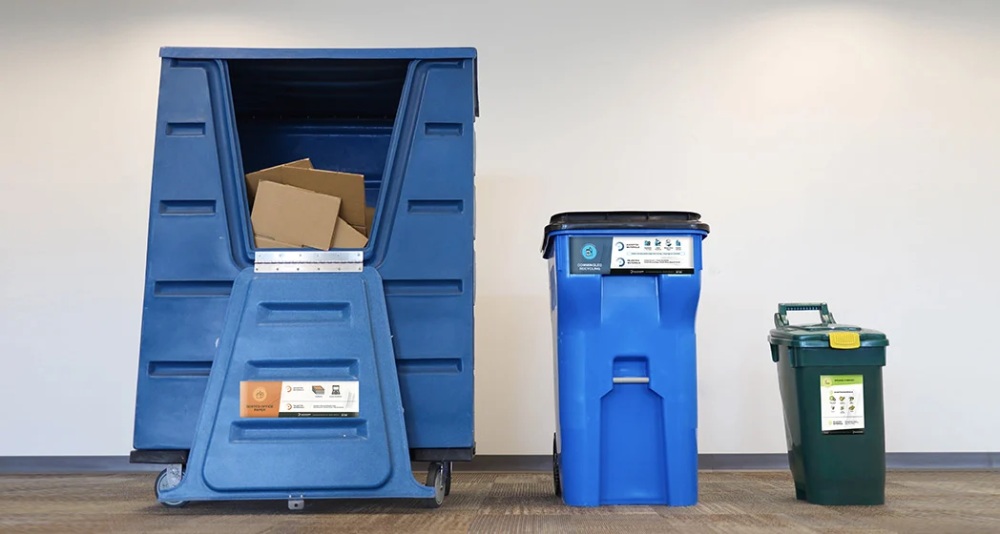
How Offices Can Improve Recycling Rates in Phoenix
The best way to improve Arizona recycling rates in an office setting is to ensure that making the right decision is easier and more intuitive than making the wrong one. That often means reducing friction at the point of disposal. If your employees have to guess or walk too far, they are less likely to take your desired action.
Strategies for improving recycling rates in commercial buildings include:
- Place recycling where recyclable materials are actually generated. Paper near printers, bottles and cans near breakrooms, and cardboard near mailrooms are more likely to be captured when containers are close to the source.
- Make trash and recycling decisions easy to understand. Employees are more likely to use the right stream when signage is clear, and the accepted materials match what the property actually collects.
- Keep container setups consistent across the office. A recycling program is easier to follow when bins look and function the same way from one area to the next.
- Support high-volume areas, not just desks and conference rooms. Break areas, copy rooms, mail stations, and back-of-house spaces often generate a large share of recyclable material and need the same level of attention.
- Adjust service when containers are consistently overflowing or underused. Recycling rates improve when pickup schedules and container placement reflect how the building is really being used instead of staying fixed.
Ultimately, your goal should be to design a system that fits the way the property actually operates.
Improving Recycling Rates with Technology and Better Service Design
When the problem is visibility, consider improving recycling rates with technology. The right software can offer information and data on fullness, contamination, and service mismatches that can directly lead to improvements, such as more precise service decisions.
Data also gives managers a clearer way to track progress over time. We always recommend a data-driven view of recycling performance rather than a set-it-and-forget-it approach.
Learn More About Our Commercial Waste Services in Phoenix, AZ
At RoadRunner, we build commercial recycling programs in Phoenix around the realities of the property, the waste stream, and the local market. Learn more about our commercial waste services in Phoenix, AZ.
